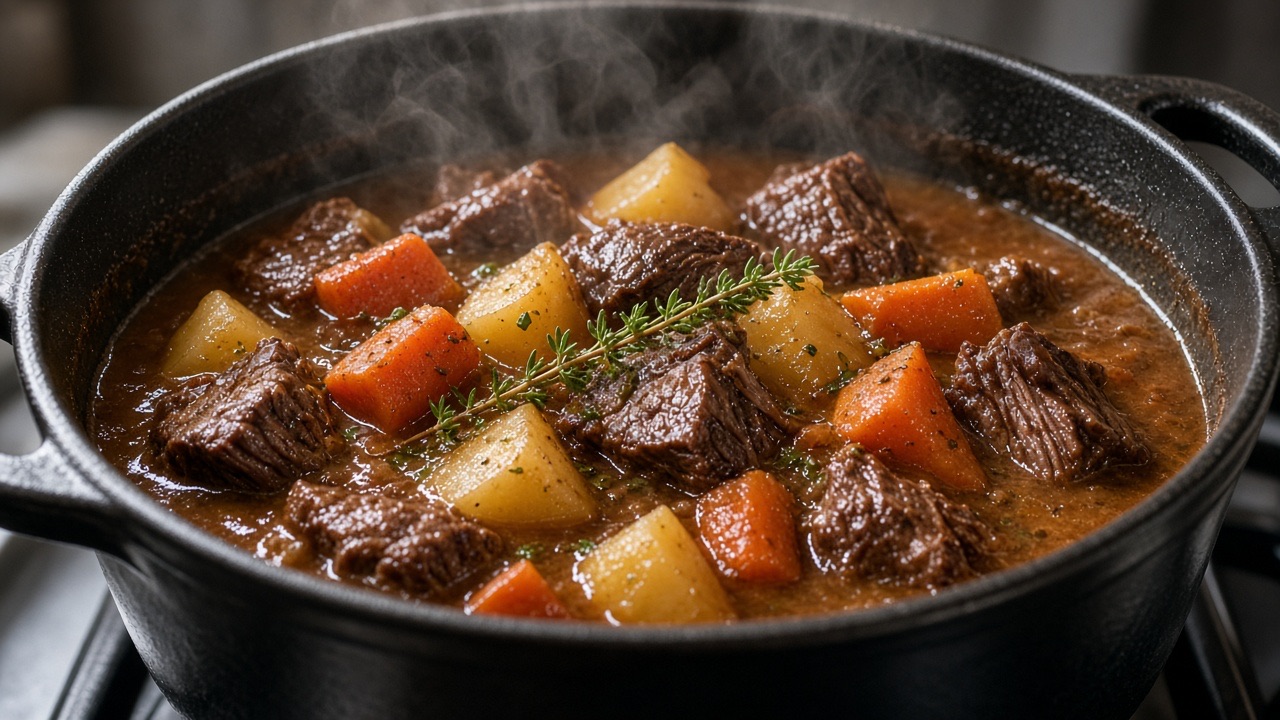
Beef stew that gets tender in the oven
Chuck, not a lean steak. Stew meat labeled "stewing beef" is often scraps that never soften. Chuck has collagen. At 160°C, covered, that collagen turns to gelatin and the chunks go tender somewhere around the two-hour mark. Boil it on the stove and the outside of the meat tightens before the inside gives. The oven is steadier.
Dry the beef before the flour. Wet meat steams. Three tablespoons of all-purpose flour is about 22 g, enough to brown and to thicken the broth. It is not a dredge you should see as a crust. Shake off the extra. The flour chart is useful if you are scaling the pot, because a heaped tablespoon is not a level one.
Brown in batches
Crowding drops the temperature and the beef boils in its own juice. You want a deep brown side, not a gray cube. The fond on the bottom of the pot is the flavor of the broth. Tomato paste cooks for a minute in the fat so it tastes sweet instead of metallic, then the broth lifts it.
Potatoes and carrots go in for the last hour. In from the start, they dissolve. 600 g of potatoes is about four medium ones. Cut them large. Small dice vanish.
The stew is done when a chunk of beef breaks with a spoon, not when the clock says so. If it is still chewy, give it another 20 minutes. If the sauce is thin, set the pot on the stove uncovered for 10 minutes. If it is too thick, add a splash of water.
It is better the next day. Cool it fast, keep it four days in the fridge, or freeze it for three months. The potatoes soften further on reheating, which is fine.